Restoring Comfort to Brooklyn Steam Heating Systems
Cast-iron steam radiators are among the most durable heating emitters ever engineered, providing deep, resonant radiant warmth throughout New York City winters. However, because steam systems operate on fundamental thermodynamic principles of gravity and air displacement, even a minor mechanical imbalance—such as a corroded air vent, an improper pipe pitch, or a leaking shutoff valve—can cause loud banging, cold rooms, or water damage to finished flooring. When homeowners require radiator repair Marine Park Brooklyn, finding technicians who truly understand low-pressure steam dynamics is essential.
Whether your heating system is installed in a detached single-family home near Avenue U or a semi-detached residence bordering Flatbush Avenue, our heating specialists diagnose distribution imbalances safely. We work in tandem with our primary boiler repair in Marine Park team to ensure that boiler operating pressures, steam headers, and terminal radiator components operate in complete mechanical harmony.
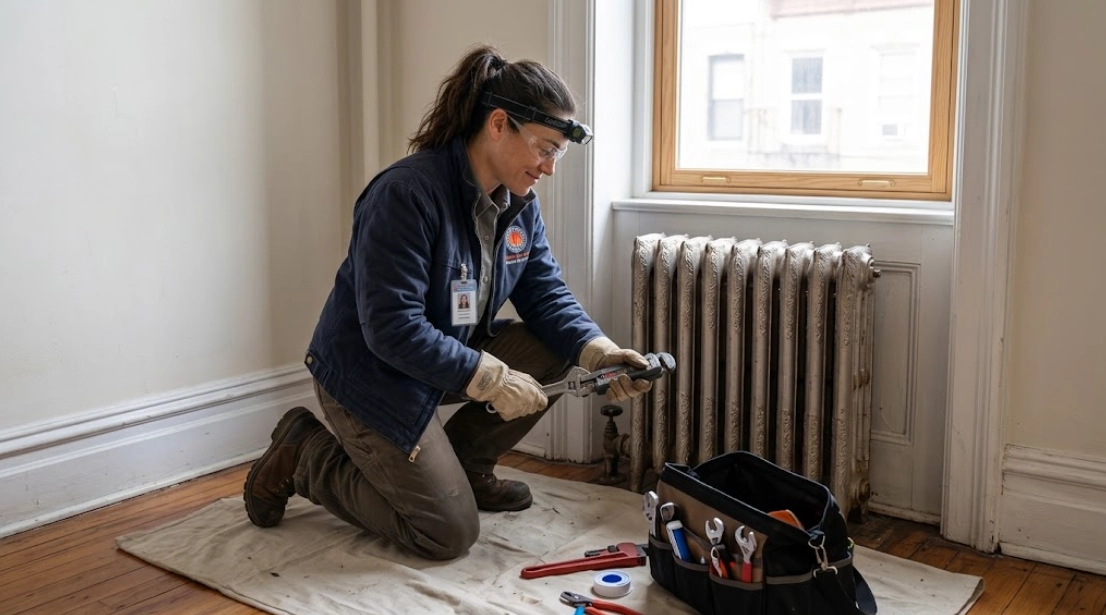
Common Steam Radiator Symptoms & Solutions
Most steam heating complaints stem from three core issues: trapped air, poor condensate drainage, or degraded mechanical packing:
1. Banging, Clanking Steam Pipes (Water Hammer)
Few household sounds are more alarming than violent banging steam pipes Marine Park Brooklyn. Water hammer occurs when rising 212°F steam slams into a pool of cooler condensed water trapped inside a horizontal pipe run or inside the radiator base. As steam rapidly condenses against cold water, a violent vacuum forms, propelling water like a solid slug against metal fittings.
Causes include:
- Improper Radiator Pitch: In single-pipe systems, radiators must gently tilt downward toward the supply valve so condensed water can drain back to the boiler. If floor joists settle and the radiator tilts backward, water pools inside the sections.
- Partially Closed Supply Valves: On one-pipe steam, the valve must be either 100% open or 100% closed. Leaving it halfway open chokes the returning condensate stream.
- Sagging Basement Mains: Uninsulated steam mains in basements that sag allow pools of condensate to collect between pipe hangers.
2. Cold Radiator in a Cold Room
When a radiator remains cold despite the boiler firing, the problem almost always traces back to trapped air. In single-pipe steam, air vents on the side of each radiator act as mechanical breathers. When the boiler turns on, rising steam pushes cold air out through the vent. Once hot steam reaches the vent, a temperature-sensitive float expands and seals the orifice. If an air vent corrodes shut, mineral scale blocks the vent, or it is sealed by coats of room paint, air cannot escape—and steam cannot enter.
3. Leaking Radiator Valves & Floor Stains
Weeping steam around the supply valve stem is another frequent issue requiring steam radiator valve replacement Marine Park Brooklyn. Over decades, graphite packing material inside the valve bonnet dries out and shrinks, allowing pressurized steam to escape around the handle. This steam condenses into boiling water, dripping onto subfloors, warping hardwood, and ruining plaster ceilings below.
Noisy or Cold Steam Radiators?
Our heating technicians re-pitch radiators, replace seized angle valves, and balance heating loops across Marine Park.
Safe Troubleshooting vs. Professional Intervention
Steam systems operate under scalding temperatures. Understanding what is safe to inspect—and what requires a professional—protects you and your family:
- What You Can Safely Check: Confirm that the radiator shutoff valve handle is turned completely counterclockwise (fully open). Ensure that curtains, furniture, or radiator covers are not blocking airflow around the thermostatic air vent.
- What You Should Never Do: Never attempt to remove an air vent, loosen a spud union nut, or disassemble a valve while the boiler is running or pressurized. Escaping steam can cause severe third-degree burns within seconds. Furthermore, older radiator spuds can shear off inside cast-iron threads if forced with improper pipe wrenches.
Restoring Balanced Whole-Home Steam Distribution
In multi-story Brooklyn homes, front bedrooms frequently roast while rear additions remain freezing cold. Balancing steam requires tuning air vent venting speeds. Technicians install calibrated, variable-orifice air vents: faster vents on distant or top-floor radiators, and slower vents on radiators close to the boiler. This allows steam to reach all radiators simultaneously, shortening boiler run times and reducing overall fuel consumption.
If your heating plant has reached the end of its useful lifespan or cast-iron sections have cracked, consult our boiler replacement guide for modern sizing solutions.
Frequently Asked Questions About Radiator Repair
In a one-pipe steam heating system, steam cannot enter a radiator unless air can escape. If the thermostatic air vent on the side of the radiator is clogged with mineral scale, stuck shut, or painted over, air remains trapped inside, completely preventing steam from heating the cast iron.
Violent banging (water hammer) occurs when high-velocity steam collides with pools of condensed water trapped inside pipes. This is commonly caused by a radiator tilted the wrong way (preventing condensate from draining back), a partially closed radiator supply valve, or a sagging floor riser.
No. On a single-pipe steam radiator, the supply valve must always be either 100% fully open or 100% fully closed. Partially closing the valve restricts the narrow orifice where steam enters and condensate drains simultaneously, leading to severe water hammer, spitting vents, and leaking valve stems.
Explore Related Services:
- Return to our primary boiler repair in Marine Park diagnostic overview.
- Explore heating upgrade planning on our boiler replacement page.
- Review local service coverage on our service areas guide.
- Reach our telephone dispatch desk directly via the contact page.